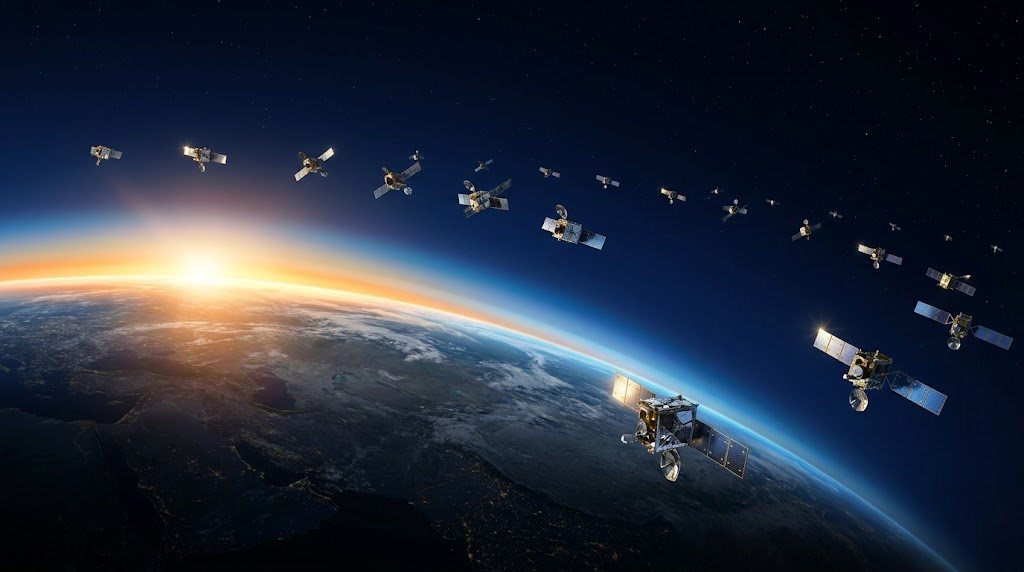
Reusable rockets have made launch routine. Now a fast-growing economy of satellites and services is being built on top of that access.
Not long ago, every trip to orbit was a major event built around a rocket that would never fly again. Reusable rockets have changed that rhythm. Launch is becoming routine, and routine access is giving rise to a commercial economy built on top of it.
For long-term thinkers, space now resembles an infrastructure story more than a science story. The rails are being laid, and a growing set of services is starting to run on them.
An Economy Already Larger Than Most Expect
The global space economy reached a record $613 billion in 2024, up 7.8% from the year before, according to the Space Foundation's Space Report published in July 2025. Commercial activity accounted for 78% of that total, with government budgets making up the rest.
The growth path looks steep. The Space Foundation said the economy could cross $1 trillion as soon as 2032. A joint report by the World Economic Forum and McKinsey, published in April 2024, projected that the space economy could reach $1.8 trillion by 2035, growing at roughly twice the expected rate of global GDP.
That report offers a helpful way to see the market. It divides activity into two parts:
- Backbone: The hardware and services that operate in space, including satellites, launch and ground stations. This segment was about $330 billion in 2023.
- Reach: The products and services on Earth that depend on space technology, such as navigation, weather forecasting and connectivity. This segment was about $300 billion in 2023 and is expected to grow faster.
Reusable Launch Changed the Tempo
The single biggest driver of this growth is launch frequency. SpaceX completed 165 orbital launches in 2025, all on its Falcon 9 rocket, according to Space.com. That beat its own previous record of 134 launches in 2024.
Reusability makes that pace possible. By the end of 2025, a single Falcon 9 first-stage booster had flown 32 times. A rocket that lands and flies again turns launch from a custom project into something closer to an airline schedule.
The effect compounds. When customers can count on frequent rides to orbit, they can plan constellations, refresh hardware more often and test new ideas faster. Predictable access is the foundation every other space business relies on.
The momentum is industry-wide. The Space Foundation noted that launch activity in the first half of 2025 ran ahead of the pace set during the record year of 2024, with most missions carrying communications satellites for broadband constellations.
From Rare Event to Regular Service
Frequent launch changes how engineers design spacecraft. When a ride to orbit is available often, teams can build smaller satellites, launch them in batches and upgrade them on a regular cycle, much as technology companies refresh software. That shift from one-off missions to continuous improvement is one of the defining features of the new space economy.
Starlink Shows What Scale Looks Like
Starlink is the clearest example of a business built on routine launch. SpaceX sent more than 3,000 Starlink satellites to orbit across 123 missions in 2025 alone, and the constellation counted more than 9,300 active spacecraft by year end.
The service keeps widening its reach. At Mobile World Congress in March 2026, SpaceX President Gwynne Shotwell and Starlink leadership introduced Starlink Mobile, the new name for the company's satellite-to-phone service, as Bloomberg reported. Key details included:
- Direct-to-phone coverage: About 650 satellites can connect directly with ordinary smartphones to fill cellular dead zones.
- Rapid adoption: The service had about 10 million monthly active users, with SpaceX expecting more than 25 million by the end of 2026.
- Next generation: SpaceX aims to begin launching larger, more capable Starlink satellites in mid-2027, with Starship expected to carry about 50 of them per flight.
The broader point extends beyond one company. Several broadband constellations, including Amazon Leo (formerly Project Kuiper) and Eutelsat's OneWeb, are building networks that bring connectivity to ships, aircraft, rural communities and remote work sites.
Connectivity from orbit has a special kind of reach. It can serve a fishing vessel in the middle of an ocean, a research station in the Arctic or a school in a remote valley with the same network. For many communities, satellites offer the fastest path to reliable internet access, and every new user expands the market for services delivered over that link.
The Services Built on Top
As launch becomes routine, the most interesting growth may sit in the reach economy. Satellites are becoming platforms for data and services that ordinary businesses use every day, often without noticing that space is involved.
Several categories are gaining momentum:
- Earth observation: Frequent imaging supports agriculture, insurance, forestry, shipping and disaster response.
- Navigation and timing: Satellite positioning underpins logistics, ridesharing, precision farming and financial networks.
- Connectivity: Broadband from low orbit links aircraft, vessels and remote operations to the wider internet.
- Weather and climate data: Better forecasts help energy producers, farmers and airlines plan ahead.
- In-space services: Satellite servicing, research platforms and manufacturing in microgravity are early but promising fields.
Each category turns orbital capability into an everyday business tool. That is why the WEF and McKinsey expect reach applications to grow faster than the hardware itself.
The talent story is equally encouraging. Space companies need software engineers, data scientists, manufacturing specialists and field technicians, and many of those skills transfer directly from other industries. The new space economy is creating careers well beyond the traditional aerospace workforce.
Universities, startups and established manufacturers are all part of this ecosystem. Small teams can now design a satellite, book a ride to orbit and deliver data to customers within a few years, a timeline that once belonged only to national programs.
Reading the Theme With a Long Lens
Space rewards patience. The industry runs on multiyear development cycles, and the companies building the backbone today are laying groundwork for services that will mature over the next decade.
A few questions can help frame the theme:
- How often can it fly? Launch cadence remains the clearest signal of how open access to orbit has become.
- Who uses the data? The strongest services solve a problem for customers who may never think about satellites.
- What scales on Earth? Reach applications often grow fastest because they plug into existing industries.
- What comes next? Larger rockets such as Starship are designed to carry far more capacity per flight, which could open room for new kinds of missions.
The View From the Ground
The new space economy is no longer a distant idea. Reusable rockets have made launch frequent, constellations are delivering real services and the market is on a path toward $1 trillion and beyond, according to leading industry estimates.
One useful exercise: look at your own industry and ask where satellite data, connectivity or positioning could add value. Many of the best opportunities in space will be found on the ground, in the businesses that put orbital capability to everyday use.
For general information only; not investment advice.
Sources
- Space Foundation, "The Space Report 2025 Q2 Highlights Record $613 Billion Global Space Economy for 2024," July 22, 2025.
- World Economic Forum and McKinsey and Company, "Space: The $1.8 Trillion Opportunity for Global Economic Growth," April 8, 2024.
- Space.com, "SpaceX shatters its rocket launch record yet again: 165 orbital flights in 2025," December 31, 2025.
- Bloomberg, "SpaceX Aims to Launch Upgraded Starlink Satellites in Mid-2027," March 2, 2026.