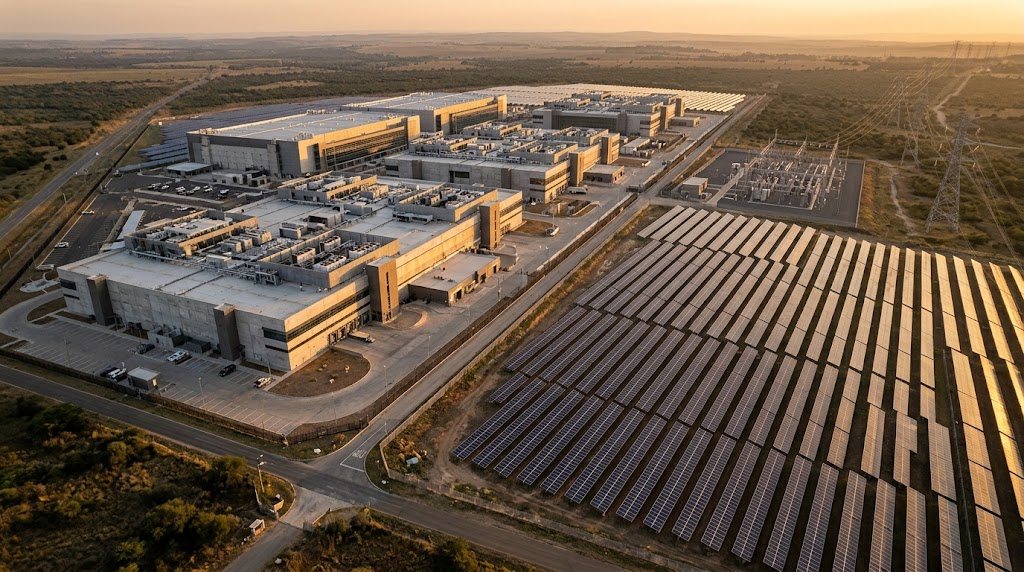
Chips, data centers and power plants are rising together. Here is a clear view of the AI infrastructure build-out and the industries growing around it.
Artificial intelligence is usually discussed as software, but its largest footprint is physical: chips, data centers, power plants and transmission lines. That physical layer has become one of the biggest private construction programs of the decade.
For anyone thinking about capital on a long horizon, the build-out is a useful lens. It shows where demand is clearest, which industries are growing alongside it and how the next wave of opportunity is likely to form.
The Scale of the Build-Out
The numbers have moved quickly. In February 2026, NVIDIA reported fiscal 2026 revenue of $215.9 billion, up 65% from the prior year. Its data center business alone generated $193.7 billion, up 68%, with $62.3 billion of that arriving in the fourth quarter.
The buyers are expanding just as fast. Reuters reported in February 2026 that Alphabet, Amazon, Meta and Microsoft were expected to invest about $650 billion in AI-related infrastructure during 2026, according to an analysis by Bridgewater Associates. That compares with roughly $410 billion in 2025.
Dedicated projects add to the total. In January 2025, OpenAI, SoftBank, Oracle and MGX announced the Stargate Project, a plan to invest $500 billion over four years in new AI infrastructure in the United States. It began with an initial $100 billion and a first campus in Texas, with Arm, Microsoft, NVIDIA and Oracle named as technology partners.
Why the Demand Keeps Building
Two forces sustain this spending. The first is training, the process of building ever more capable AI models, which requires enormous clusters of chips running for weeks at a time. The second is inference, the work of answering questions and completing tasks once a model is deployed.
Inference grows with usage. Every new customer, every new application and every new AI agent adds steady demand for computing. That is why many builders describe today's capacity not as a one-time project but as the early stage of a utility that people and businesses will draw on every day.
Chips: The Engine Room
Accelerated computing sits at the center of this cycle. In its February 2026 results, NVIDIA said its Blackwell Ultra systems deliver up to 50 times the performance of the earlier Hopper generation on agentic AI workloads, based on independent industry benchmarks.
The next platform is already defined. NVIDIA's Rubin architecture spans six new chips and is designed to make each AI response far more efficient to produce, with the company citing up to a tenfold gain in inference efficiency over Blackwell. AWS, Google Cloud, Microsoft Azure and Oracle Cloud are expected to be among the first to offer Rubin-based systems.
Jensen Huang framed the moment plainly in the same release, saying that computing demand is growing exponentially and that the agentic AI inflection point has arrived. Agentic AI refers to systems that plan and complete multistep tasks, and those systems consume far more computing than a single question and answer.
Each generation also tends to broaden the market. As AI becomes more efficient to run, more businesses can put it to work, from hospitals reading scans to manufacturers inspecting parts on a production line. Efficiency gains have historically expanded total demand for computing rather than shrinking it.
Power: The New Strategic Asset
Every rack of accelerators needs reliable electricity, which has turned power into a strategic asset. The International Energy Agency projected in April 2025 that global electricity demand from data centers will more than double by 2030 to around 945 terawatt-hours. Demand from AI-optimized facilities is expected to more than quadruple over the same period.
That growth is drawing fresh investment into energy of every kind. Three developments show the range:
- Renewables and natural gas: The IEA expects these two sources to take the lead in meeting new data center demand through 2030, supported by their availability in key markets.
- Restarted nuclear capacity: In September 2024, Microsoft and Constellation signed a 20-year agreement to restart a Pennsylvania reactor as the Crane Clean Energy Center, adding about 835 megawatts of carbon-free power with operations originally targeted for 2028 and now expected as early as 2027.
- Next-generation nuclear: In October 2024, Google agreed to buy 500 megawatts from a fleet of seven small modular reactors developed by Kairos Power, with the first unit targeted for 2030.
The benefits reach local economies as well. Constellation cited an economic impact study estimating that the Crane restart will support about 3,400 direct and indirect jobs in Pennsylvania.
The Industries Growing Around the Core
The build-out pulls a long supply chain forward with it. Each new campus requires land, construction crews, steel, concrete, cooling systems, transformers, fiber and skilled technicians. Many of these are established industries entering a new growth chapter.
Several adjacent areas stand out:
- Cooling: Dense AI racks generate far more heat than traditional servers, which is accelerating the move to liquid cooling.
- Electrical equipment: Transformers, switchgear and backup systems are central to every new facility.
- Networking: High-speed interconnects and optical links let thousands of chips work together as one system.
- Skilled trades: Electricians, pipefitters and commissioning engineers are in demand wherever new campuses rise.
- Applications: The capacity built today becomes the foundation for AI tools in healthcare, finance, logistics and education.
The pattern echoes earlier infrastructure eras. Railroads created demand for steel and new towns. Electrification gave rise to utilities and appliance makers. The internet produced cloud computing and online commerce. In each case, the value spread well beyond the first builders.
Regional economies feel the lift as well. New campuses bring construction work, long-term operations roles, upgraded grid connections and fresh demand for local suppliers. Communities with available land and power are finding that the AI era can be a source of durable local growth.
A Simple Framework for Long-Term Thinking
Infrastructure cycles reward patience and a clear framework. Rather than following daily headlines, long-horizon thinkers tend to return to a handful of durable questions:
- Where is demand committed? Multiyear power agreements and announced capital plans signal real intent.
- Which bottlenecks are being solved? Power, cooling and grid connections often set the pace at which new capacity arrives.
- Who benefits from use, not just construction? The applications built on this capacity may prove as meaningful as the hardware itself.
- Which regions are gaining? Places with available land, power and talent are attracting new campuses and the jobs that come with them.
None of these questions requires a forecast. Each simply helps separate lasting structural change from passing excitement.
Following the Build-Out From Here
The AI build-out is one of the clearest long-term themes in the economy because it is visible, measurable and backed by committed capital. Chips, power and the industries around them are growing together, and each layer creates room for new companies, new careers and new ideas.
A practical next step: choose one layer of the stack, such as power, cooling or AI applications in your own industry, and follow it for a quarter. Read the company announcements, note new projects in your region and watch where capacity comes online. Understanding the physical side of AI makes the software side much easier to see.
For general information only; not investment advice.
Sources
- NVIDIA, "NVIDIA Announces Financial Results for Fourth Quarter and Fiscal 2026," February 25, 2026.
- Reuters, "Big Tech to invest about $650 billion in AI in 2026, Bridgewater says," February 23, 2026.
- OpenAI, "Announcing The Stargate Project," January 21, 2025.
- International Energy Agency, "Energy and AI," April 10, 2025 (as reported by the American Public Power Association, April 11, 2025).
- Constellation Energy, "Constellation to Launch Crane Clean Energy Center, Restoring Jobs and Carbon-Free Power to the Grid," September 20, 2024.
- NucNet, "Google Signs World-First Deal to Buy Power From Small Modular Reactors for Data Centres," October 15, 2024.